
Two educators in one classroom can lead a single group, teach in parallel, rotate stations, or pull a smaller group for focused work. A room planned only for rows facing one wall makes those shifts awkward. For a Greenwood modular classroom, the team should test the teaching models it actually uses and provide space for movement, materials, and conversation around them.
For the wider project picture, explore Indiana modular buildings alongside your classroom space plans.
Stage several teaching models on the plan
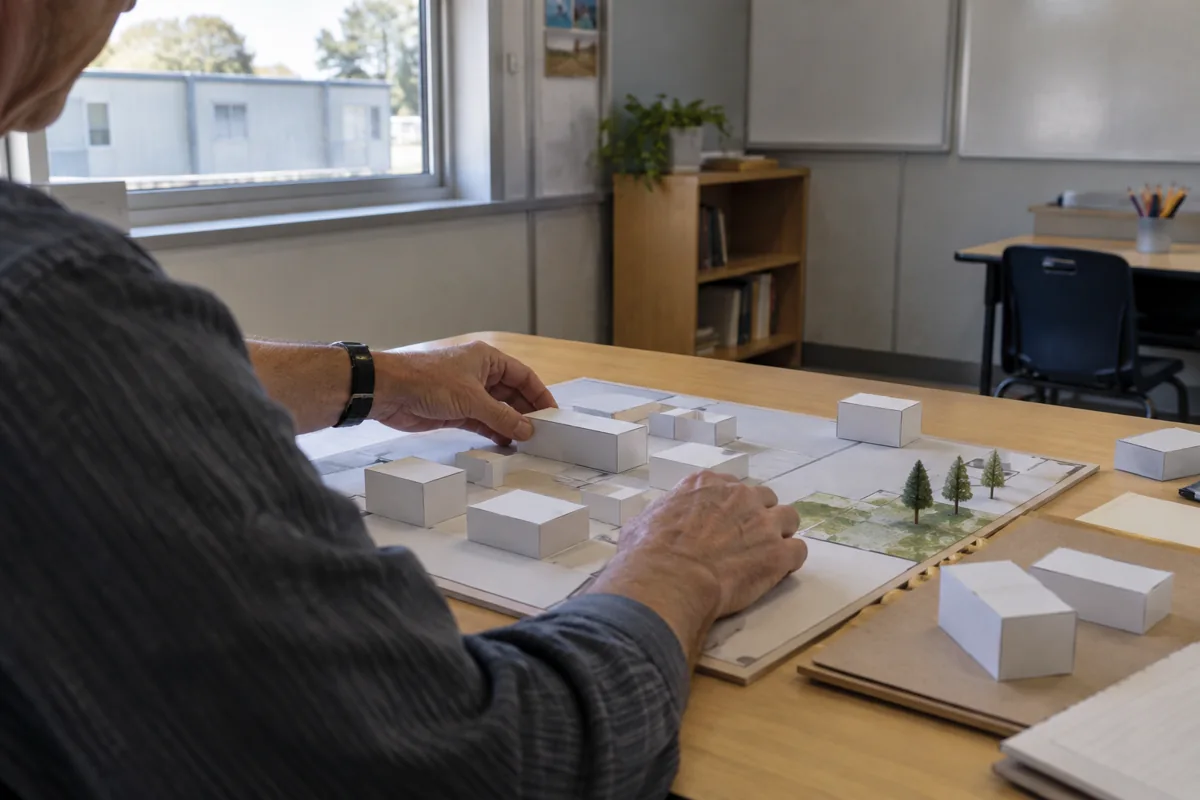
Place students, both educators, displays, storage, and accessible routes for whole-group, parallel, station, and small-group setups. Note where sound from one activity interferes with another and how staff maintain visibility. A small adjoining room may be useful for intervention, but it should not become a remote space that is difficult to supervise or disconnected from classroom materials.
Furniture type matters. Heavy fixed casework can limit useful arrangements, while entirely mobile storage may create clutter and unstable room edges. The modular classroom layout guide can support comparisons, but scaled furniture and the real class routine must prove them.
Transitions between teaching models should not consume the lesson. Time one representative change and note what students and staff move. If a five-minute regroup requires relocating bags, searching for materials, and reconnecting technology, the flexible plan is adding friction. Small distributed supply points may be worth more than one remote storeroom.
Give both educators a functional base
Co-teachers need access to technology, instructional materials, student work, and a place for brief planning without duplicating everything. Decide which resources are shared, where private records remain secure, and how each teacher controls or views classroom displays. The answer may favor distributed storage and more than one presentation position.
Acoustic separation, interior glazing, door hardware, accessibility, and applicable Indiana or local education and building requirements require project-specific review by qualified professionals and authorities. Room names alone do not establish how a space may be occupied or supervised.
Keep flexibility features in the price record
Movable partitions, acoustic assemblies, added displays, furniture, floor boxes, charging, casework, and interior windows may appear as options or exclusions. Use the complete modular cost guide to compare them with the building, site, foundation, delivery, utility, and closeout work. Ask which teaching setup becomes unavailable when a feature is removed.
When Greenwood educators can run several class formats without losing circulation or preparation space, the owner can compare current classroom prices. A successful plan will not force one teacher to orbit the other. It will make collaboration and regrouping ordinary enough that the physical room fades behind the lesson.