
Get prices on Cape Coral modular church space that connects ministry needs with documented site conditions and assigned technical questions. Access, drainage, foundations, utilities, equipment service, storage, and room usefulness should remain visible instead of being buried in a generic site allowance.
For the wider project picture, explore Florida modular buildings alongside your church space plans.
Separate what is known from what must be learned
Collect available surveys, utility records, existing plans, and relevant property information. Map parking, accessible travel, fire access, drainage, exterior equipment, deliveries, property edges, outdoor use, and setting access.
Label verified records, observations, provider assumptions, and unresolved investigation separately. Give every open question an owner, affected option, and next action.
Maintain a condition log with source and date. When new evidence changes a route, foundation assumption, utility approach, or scope item, update the comparison visibly.
Identify which unresolved condition controls each option most strongly. Move high-impact investigation ahead of finish selections so the committee does not refine a layout built on a fragile assumption.
Use church community plans to study room relationships only after a candidate site area remains credible.
Keep ministry outcomes attached to the site
List intended programs with attendance, overlap, sound, privacy, supervision, technology, furniture, restrooms, storage, setup, and cleanup. Define the smallest operating zone and busiest transition.
Trace families, volunteers, and people using mobility devices from parking or drop-off to entry, occupied rooms, support, and exits. Record comfort and shelter goals for professional design.
Note which ministry materials require protected delivery and storage. Technology, curriculum, hospitality supplies, furniture, and cleaning items may need different routes from the public entrance.
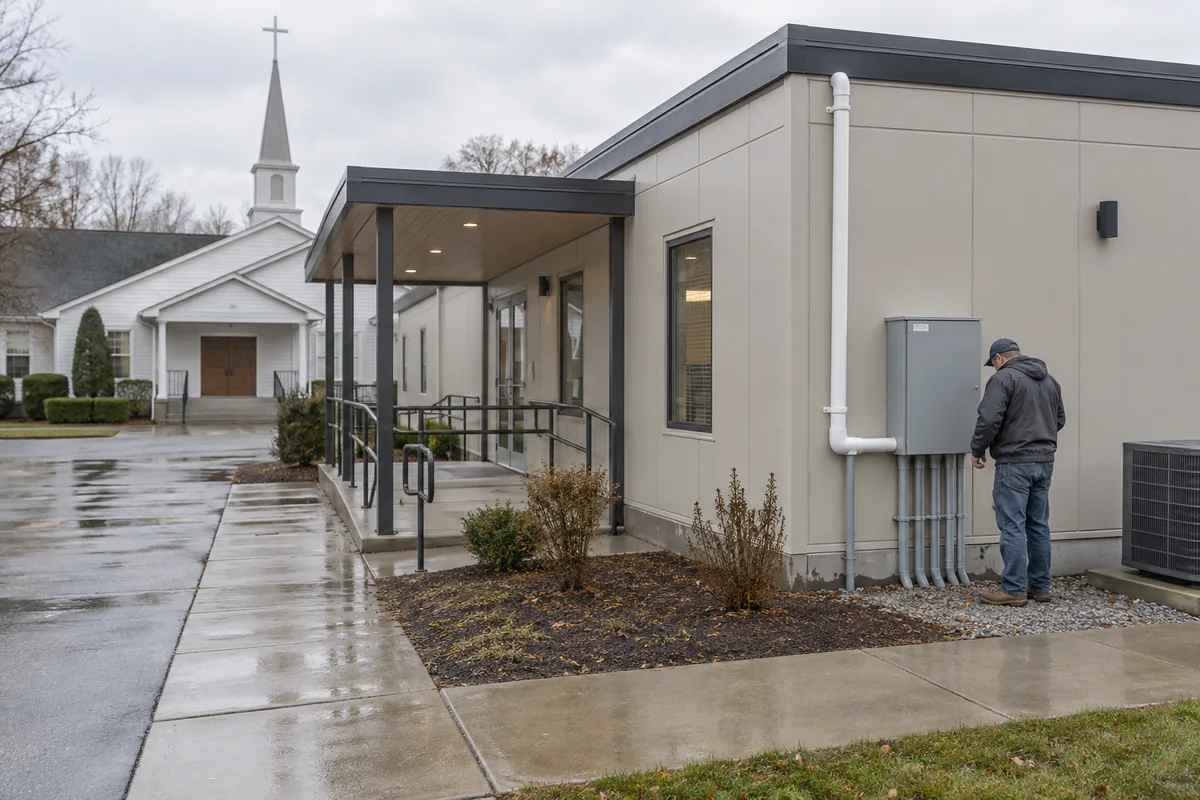
Protect access to panels, shutoffs, filters, utility connections, drainage components, and equipment after fencing, landscape, storage, or events are considered.
A Cape Coral church can clarify its price comparison by tagging each item confirmed, assumed, or unresolved. Keep the ministry outcome beside each site question so open utility, access, or drainage information is visible rather than hidden in a low preliminary number. That confirmed/assumed/unresolved split makes Florida modular church pricing easier to review without hiding site unknowns.
Price confirmed scope and open conditions separately
Normalize investigation, design, factory work, transport, foundations, set, utilities, site work, exterior access, drainage interfaces, equipment support, storage, permits, finishes, testing, documentation, and closeout. The project cost guide helps expose gaps.
Ask providers to state site and product assumptions, owner work, allowances, evidence still needed, and decisions reserved for qualified professionals. Do not let an open condition become an implied inclusion.
Request a meaningful alternative when one site interface drives the plan. A revised footprint, entrance, or support relationship may preserve the ministry goal while reducing dependence on unresolved evidence.
Have ministry operators test room use while facility and professional reviewers test routes, interfaces, and unresolved evidence. Keep comments tied to the exact option.
With the ministry and evidence brief attached, request Cape Coral modular church prices. Favor the response that explains usable scope and remaining uncertainty with equal care.